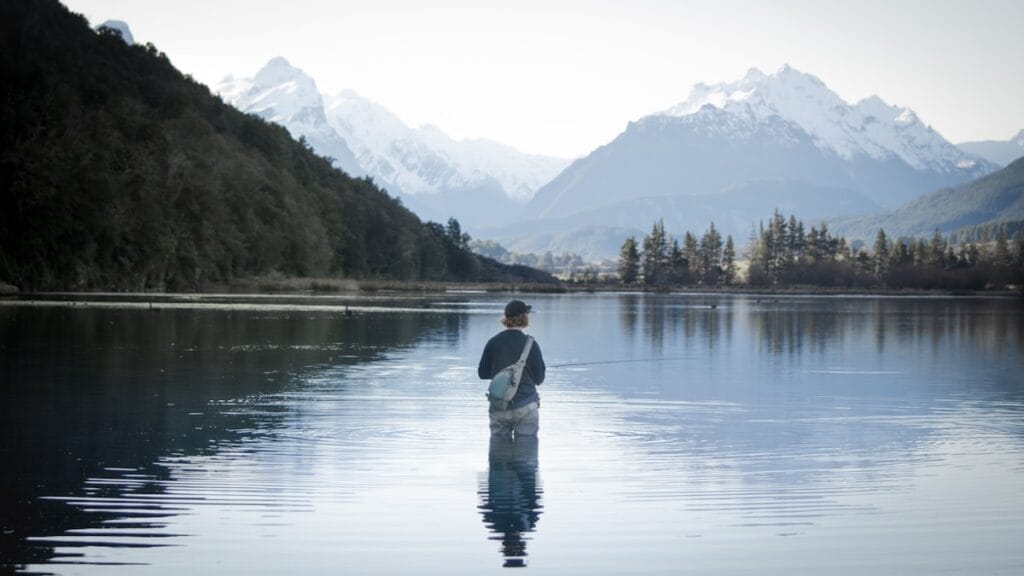
Bass don’t distribute evenly across a lake. The same body of water that produced zero fish in one area holds double-digit stringers two coves over. The difference is almost always structure, cover, and the depth transition between them. Learn to read water and you can walk up to any unfamiliar lake and identify productive spots in minutes.
Understanding What Bass Need
Bass are ambush predators. They position where they can access food, hide from predators, and regulate their body temperature — ideally in one location that satisfies all three. The best bass fishing spots in any lake combine:
- Structure: A change in the bottom contour — a point, drop-off, hump, or channel edge
- Cover: Something to hide near or in — weeds, rocks, wood, docks
- Depth access: Proximity to deeper water for quick retreat or thermal regulation
- Food: Baitfish, crawfish, or other forage nearby
The more of these elements that overlap in one spot, the better the spot. A bare, featureless flat almost never holds many bass. A submerged point with brush on the deep end adjacent to a spawning cove can be a gold mine year-round.
Best Bass Fishing Spots by Type
Points
Points are the most consistently productive bass locations in any lake. A point is a piece of land that juts out into the water, creating a submerged finger of structure that extends from shallow to deep.
Main lake points connecting deep water to shallow coves are year-round producers. Bass use them as staging areas in spring, feeding zones in fall, and migration highways between seasonal haunts. Focus on the 6–15 foot range on the point and fish both sides.
The best points have hard bottom (gravel, rock, or clay), irregular edges, and some form of cover (brush piles, stumps, or laydowns at the tip).
Creek Channel Swings
In reservoirs built on flooded river valleys, the old creek and river channels are the bass’s highway system. Where a channel swings and cuts close to a bank, it creates a depth change and current deflection point that bass love.
Fish the outside bends of creek channels (deeper, harder bottom) in summer. In spring and fall, bass use the channel swings as migration staging areas. A Carolina rig or deep-diving crankbait along the channel edge produces fish year-round.
Laydowns and Fallen Trees
A large tree that has fallen into the water is one of the best individual bass-holding features on any lake. The trunk, branches, and root ball create a three-dimensional habitat that appeals to bass in every season.
The best laydowns have their root ball or thick end in deeper water (8+ feet) with the branches extending into shallower water (2–4 feet). This gives bass thermal access in summer and escape routes in winter. A big oak or cypress that fell into 6–10 feet of water can hold bass 12 months a year.
Fish the shaded side first, then the deeper end. In summer, the deepest branches hold the biggest fish. In spring, females move toward the shallow end near spawning flats.
Grass Beds and Weed Lines
Aquatic vegetation is the richest bass habitat in most natural lakes and many reservoirs. Hydrilla, milfoil, lily pads, eel grass, and coontail all provide oxygen, cover, and a food chain that supports large populations of bass.
The outside edge of a grass bed where vegetation meets open water is typically the most productive strip. Bass position along this edge to ambush baitfish. Fish parallel to the edge with a weedless presentation (Texas rig, frog, flipping jig) for best results.
Inside turns and pockets in a weed edge — places where the grass line retreats — concentrate bass further. Irregularity in the weed edge is a trigger point.
Docks and Boat Houses
Docks are artificial structure but bass adopt them readily. The shade, the cables, the vertical pilings, and the disrupted light patterns all create ambush opportunities. In many managed lakes, docks are the most consistent bass producers on the entire body of water.
The best docks for bass have deep water nearby (8+ feet under or adjacent), older construction (more algae growth = more food chain), a variety of features (angled supports, swim platforms, ladders), and are located near the main lake channel or on productive points.
Skip presentations (skipping jigs, soft sticks, or paddle tails) under docks reach fish that no vertical presentation can access. Learn to skip accurately and your dock bite will improve dramatically.
Rock Piles and Riprap
Rocky structure holds heat in spring and early fall and provides perfect crawfish habitat year-round. Bass near rock are often targeting crawfish, so jig and craw-imitating presentations excel.
Riprap (rock placed along dam faces, causeways, and bridge abutments) is some of the most consistent bass structure available. It combines hard bottom, irregular edges, and depth variation. Work a tube bait or football jig along riprap edges in any season.
Natural rock piles on the lake floor are best found with a graph — they show up clearly as irregular high spots above the surrounding bottom.
Humps and Submerged Islands
A hump is a high spot on the lake floor surrounded by deeper water on all sides. They don’t connect to the bank and are completely invisible from the surface. Finding them requires a contour map and a depth finder.
Productive humps typically top out at 8–15 feet below the surface with 20–30+ feet of water surrounding them. During summer, bass use humps the same way they use ledges — as feeding stations above deep water. Big crankbaits and Alabama rigs worked over the hump top can produce incredible days when the fish are active.
Spawning Flats
Flat, protected areas with firm bottom in 1–6 feet of water are spawning sites in spring. Pea gravel, sandy bottom, or sparse hard-bottom grass in protected coves is where you find bedding bass from late March through May depending on latitude.
In spring these areas hold concentrations of big females (pre-spawn) and active males (on beds). Outside of spring, spawning flats are generally less productive, but the nearby staging areas (secondary points, channel edges adjacent to the flat) hold fish year-round.
How to Use a Contour Map to Find Bass Spots
If you’re fishing an unfamiliar lake, pull up the lake on Navionics or the manufacturer’s built-in mapping on your graph before you launch. Here’s what to look for:
- Identify spawning coves: Protected, shallow (2–6 foot) coves with gradual depth changes. These are bass nurseries in spring and hold fish all year.
- Trace the creek channel: Follow the old creek or river channel through the lake. Mark every swing and bend — these are staging areas.
- Find tightly spaced contour lines: Where depth lines bunch together, the bottom drops quickly. These drop-offs are natural bass highways.
- Note points extending into the channel: Any point that juts toward deep water is a high-priority target.
- Look for isolated structure: Humps, isolated depth changes, and submerged points away from the bank.
Matching Spots to Seasons
The same lake fishes very differently in January versus July. The best bass fishing spots shift with the seasons:
- Winter: Deepest available structure. Main lake points, bluff walls, deep channel bends (15–30+ feet).
- Pre-spawn/Spring: Transition areas between deep and shallow. Points, channel swings near coves, secondary points (8–15 feet).
- Spawn: Shallow flats with firm bottom. Protected coves, quiet pockets (1–6 feet).
- Post-spawn/Early summer: Secondary points, dock rows, outer grass edges (6–12 feet).
- Summer: Deep structure. Ledges, humps, deep main lake points (15–25+ feet).
- Fall: Back of creeks, shallow grass, laydowns. Following shad into the shallows (2–10 feet).
Final Thoughts
Reading water is a skill that compounds over time. Every lake you fish teaches you something about the next one. The fundamentals — structure, cover, depth access, forage — never change. Once you internalize these principles, a new lake becomes an exciting puzzle rather than an overwhelming mystery.
Start with points and laydowns on an unfamiliar lake. They produce fish in every season and will give you a baseline read on the lake’s depth, clarity, and baitfish population. From there, expand to more subtle structure as you learn the water.
❓ Frequently Asked Questions
Where are the best spots to fish for bass in a lake?
The best bass spots combine structure (a change in bottom contour) with cover (something to hide near) and depth access. Points, laydowns, dock edges, weed edges, and creek channel bends are the most consistently productive locations in any lake.
How do I find bass in a new lake?
Study the contour map on Navionics before you launch. Find the creek channel, identify points where it swings close to a bank, and look for spawning coves with gradual depth changes. Start fishing the main lake points and work progressively into coves.
What structure holds the most bass year-round?
Main lake points connecting deep water to shallow coves are the single most consistent year-round bass structure. They serve as migration highways in spring and fall, feeding zones in summer, and staging areas in winter — all in one location.
Where do bass go in summer in a lake?
In summer, bass move to deep structure — ledges, humps, deep main lake points, and submerged islands at 15–25 feet. They follow shad schools over deep water and suspend just below them. Electronics are essential to locate summer bass effectively.
📖 Keep Reading
- → Ledge Fishing for Bass: The Complete Guide to Finding and Catching Deep Summer Bass
- → The 6 Best Bass Lures for Bank Fishing (These Actually Catch Fish)
- → How to Fish Docks for Bass: A Complete Structure Fishing Guide
- → Fall Bass Fishing: How to Find and Catch Bass as the Seasons Change
- → Winter Bass Fishing: How to Catch Bass in Cold Water
- → Bass Fishing in the Rain: Does Rain Make Bass Bite Better?
- → Bass Fishing with Live Bait: Best Baits and How to Rig Them
- → How to Catch Smallmouth Bass: Tactics, Locations, and Best Lures
- → How to Fish a Swimbait for Bass: Rigging, Retrieve, and When to Use One
- → How to Catch Bass in Summer: Beat the Heat and Find Fish All Day
- → Bass Fishing in Wind: How Wind Affects Bass and Where to Find Them
- → Topwater Bass Fishing: Lures, Techniques, and When to Fish the Surface
Sandro
Bass Fishing Enthusiast & Founder of Bass Fishing Blueprint
Sandro has been chasing bass from the bank and the boat for over a decade. He created Bass Fishing Blueprint to share straightforward, practical tactics that help everyday anglers catch more fish â no fluff, no filler, just what actually works on the water.