 bank fishing (These Actually Catch Fish)” style=”width:100%;height:auto;display:block;”>
I’ve been throwing lures at bass from the bank since I was old enough to tie a knot. No boat, no trolling motor, no fish finder. Just me, a rod, and whatever stretch of bank I could reach. And after a whole lot of years doing it that way, I can tell you this — the lure you tie on matters a lot less than most people think, right up until it matters more than anything.
What I mean is this: a decent angler with the right lure for the conditions will outfish a skilled angler with the wrong one. Every time. And when you’re fishing from the bank, you don’t have the luxury of repositioning every five minutes or covering open water from multiple angles. You’ve got to make smart decisions about what’s on your line before you even make your first cast.
These are the six lures I’d grab if someone handed me a single tackle box and told me to go catch bass from the bank. Not the most popular lures. Not the ones on TV. The ones that actually work.
1. The Texas-Rigged Senko (Gary Yamamoto 5-Inch)
If I had to fish one lure for the rest of my life from the bank, this is it. No question.
The Gary Yamamoto Senko — or any quality stick bait, really, but the original is still the best — is the most reliable bass catcher I’ve ever thrown. It doesn’t look like much. It doesn’t do anything flashy. You cast it out, let it sink on a semi-slack line, and watch that thing shimmy and shake on the way down. Bass absolutely cannot leave it alone.
The reason it works so well for bank fishing specifically is the presentation. You’re not burning it back to you. You’re not cranking fast. You cast it, you let it do the work, and you stay in contact with the line. From the bank that means you’re not fighting current, not worried about depth — you’re just fishing. Most of my bites on a Senko come on the fall before I even start a retrieve.
Rig it Texas-style, weedless, with a 3/0 or 4/0 wide gap hook and zero weight. Maybe a 1/16 oz bullet weight if there’s a little current or you need to punch through a mat. Green pumpkin and watermelon red are my go-to colors. If the water’s stained, I’ll go darker — black and blue, or junebug.
Fish it slow. Painfully slow. Cast it near anything — a dock edge, a laydown, a weed line, a chunk of rock — and let it sink all the way to the bottom. Twitch it twice, let it fall again. Repeat. The bite usually feels like your line just got heavy, or you’ll see it tick sideways before you feel anything. When that happens, reel down and swing.
2. The Lipless Crankbait (Strike King Red Eye Shad or Rat-L-Trap)
When I want to cover water fast and figure out where the bass are sitting, I reach for a lipless crank. The Strike King Red Eye Shad and the original Bill Lewis Rat-L-Trap have probably accounted for more bass from the bank than any other hard bait I’ve ever used — and it’s not close.
The thing about lipless crankbaits for bank fishing is the cast. These things fly. A half-ounce Red Eye Shad on 15-lb fluorocarbon will land 60, 65 feet away without much effort. That’s important when you’re limited in where you can stand. You can cover a long stretch of bank, hit multiple depth ranges, and burn through the water column in a way that jigs and soft plastics just can’t match.
My favorite way to fish one is what a lot of people call “yo-yoing” — cast it out, let it sink to the bottom, then rip it up two or three feet and let it flutter back down. That falling action on the pause is what triggers most of the strikes. Bass hit it on the drop constantly. Chrome with a blue back in clear water. Chartreuse in muddy or stained water. Red — plain red — when bass are feeding shallow in the spring.
The other way I fish them is straight retrieves with the rod tip down, keeping it in the 2-4 foot range. Over grass flats in the summer this absolutely lights up. You’ll feel the grass catch the bait, rip free, catch again — and that erratic action drives bass crazy.
3. Topwater — Buzzbait or Walking Bait (Heddon Zara Spook)
There is nothing in fishing that beats a topwater blow-up. Nothing. Not a 5-pounder on a jig, not a bass that jumps three times — nothing. When that surface explodes on a buzzbait at first light, it doesn’t matter how long you’ve been fishing. Your heart still races.
From the bank, topwater is your window. That window is early morning and late evening — the 45 minutes before full sunrise and the hour before dark. During that time, especially in summer, bass will be stacked shallow, feeding on baitfish near the surface, and a buzzbait or a walking bait will get crushed.
For buzzbaits I keep it simple — a white or chartreuse Strike King Buzz King or a Booyah Buzzbait. Nothing fancy. Cast parallel to the bank, keep your rod tip up, retrieve fast enough to keep the blade churning. The moment it hits the water, start reeling. Don’t give a bass a chance to look at it too long.
For walking baits, the Heddon Zara Spook is the classic for a reason. It takes about five minutes to learn the walk-the-dog cadence — slack, slack, pull, slack, slack, pull — but once you get it, it’s deadly around open water, over flats, and near dock edges. The 3-inch Baby Spook is worth having too for smaller bass or tough conditions.
One thing about topwater from the bank: don’t set the hook the second you see the explosion. Wait until you feel the weight of the fish. I’ve missed more topwater bass than I can count by swinging too early. Let the fish turn down with it first.
4. The Ned Rig (Z-Man TRD + Ned Head Jig)
If you’re not throwing a Ned rig yet, you’re leaving fish in the water. I resisted this one longer than I should have. Looked too simple. Looked too small. Then I tied one on during a midday summer trip when nothing was biting and caught seven bass in two hours. Converted ever since.
The Ned rig is as basic as it gets: a small mushroom-head jig, usually 1/6 oz or 1/4 oz, paired with a 2.75-inch or 3-inch soft plastic — the Z-Man TRD (The Real Deal) being the standard. Z-Man’s ElaZtech material floats at rest, which means the tail of the bait lifts up off the bottom. That buoyant tail waving in the current or on a pause is irresistible to bass that aren’t in a feeding mood.
This is a finesse bait. That means light line — 6 to 8 lb fluorocarbon, or 10 lb braid with a fluoro leader if you’re around vegetation. Small hooks, small profile. It works best in clear to lightly stained water on hard or mixed bottoms. Cast it out, let it hit the bottom, and drag it slowly. Lift the rod tip slightly, let it fall. That’s really it.
What makes this exceptional for bank fishing is how little water you can cover with it and still be effective. You don’t need to fan cast a whole cove. Cast to a specific rock, a specific patch of sand, work it ten feet and move to the next target. In late summer and in cold-front conditions when bass are neutral and tight to bottom, nothing else comes close.
5. The Spinnerbait (Strike King Premier Plus or War Eagle)
Spinnerbaits get slept on. I hear guys write them off as “old fashioned” or say they don’t fish them anymore. Fine by me — more fish for the rest of us.
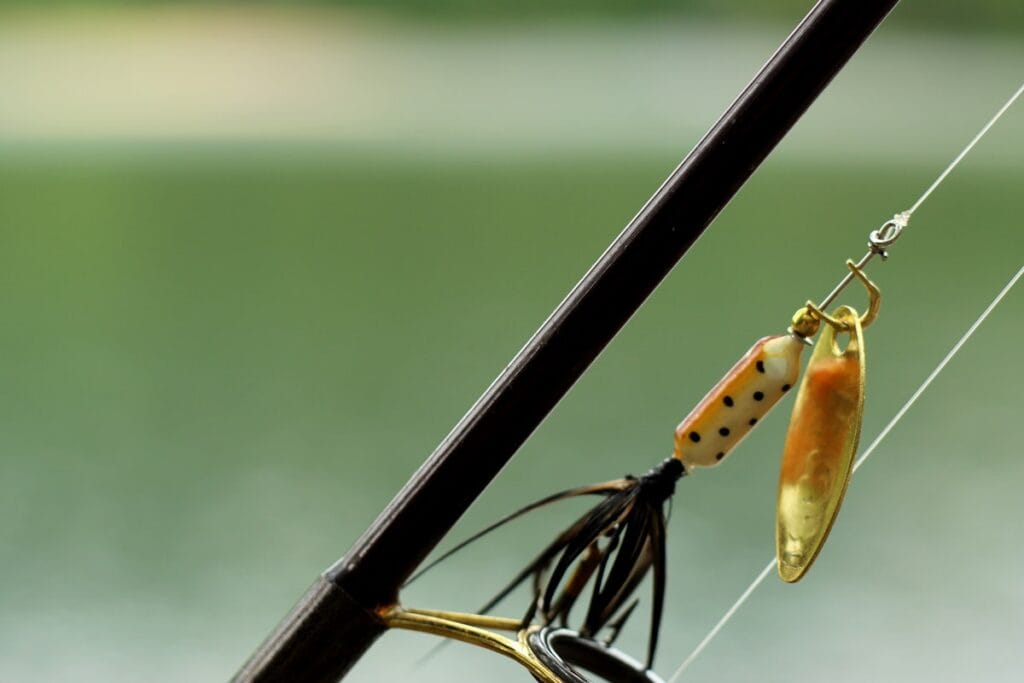
A 3/8 oz spinnerbait with a tandem willow blade is one of the best bank fishing lures going, especially around any kind of structure — dock posts, fallen timber, laydowns, bridge pilings. It deflects off cover instead of getting snagged, and that deflection is often what triggers the bite. Cast it past the structure, bring it through, bump it off that log or piling, and hang on.
Chartreuse and white are the money colors. In clear water, a subtle shad pattern — white with silver blades — is better. In muddy water I’ll bump up to a full-size 1/2 oz in chartreuse and put a Colorado blade on the front for more thump and vibration.
The Strike King Premier Plus has been in my box for fifteen years. It comes through cover clean, the blades spin true right out of the package, and the wire gauge is stiff enough that you can horse a fish out of a brush pile without it bending. The War Eagle is another one worth having — especially the finesse model for clear water and pressured fish.
Fish it with a medium-heavy rod, 15 to 17 lb monofilament or fluoro, and just burn it back. Keep the rod tip between 9 and 10 o’clock, vary the retrieve speed, and slow-roll it near the bottom in cold water. When a bass kills it, just reel. The spinnerbait hook sets itself most of the time.
6. The Flipping Jig (Strike King Hack Attack or Dirty Jig)
Every piece of visible cover you can see from the bank has a bass in it — or had one recently. That dock, that brush pile, that clump of lily pads, that laydown reaching into the water. A bass is in there. The question is whether you can get a bait to it without spooking it, and whether the bait looks enough like food to make it react.
A 3/8 oz flipping jig answers both those questions. It falls straight. It’s compact. It looks like a crawfish, which is one of a bass’s primary food sources. And with a proper trailer — I like the Zoom Super Chunk or a Keitech Swing Impact in craw colors — it’s a convincing meal.
The technique from the bank is simple: pitch or flip the jig to the far edge of the cover, let it fall on a semi-slack line, and watch for the line to jump or go sideways. If nothing happens on the fall, shake it a couple times on the bottom, then hop it out slowly. A lot of bites happen on that very first fall into a new piece of cover — the bass doesn’t have time to think about it.
I use the Strike King Hack Attack in heavy cover — thick grass, laydowns, matted pads — because the wire guard is stout enough to actually protect the hook. For dock fishing and open-structure targets, the Dirty Jig No-Jack is excellent and comes through cleaner. Either way, go with green pumpkin as your starting color and adjust from there.
Fish this on a heavy rod — 7-foot medium-heavy to heavy, 17 to 20 lb fluorocarbon. You’ll need the backbone to pull bass out of the stuff they’re hiding in.
Which One Should You Start With?
If you’re brand new to bank fishing for bass and you want to buy one lure today, get a pack of Gary Yamamoto 5-inch Senkos in green pumpkin. Learn to rig it Texas-style, weightless. That single lure, fished slow near any cover you can find, will catch you bass in just about any conditions in just about any lake or pond in the country.
Once you’ve got that down, add a lipless crankbait for covering water and a small topwater for early mornings. You’ve already got 80% of what you need to be dangerous from the bank.
The rest of these lures fill in the gaps — the Ned rig for slow, finesse days; the spinnerbait for big chunks of visible structure; the jig for working specific heavy cover. You don’t need them all at once. You need to fish the ones you have confidence in.
Because at the end of the day, the best bass lure is the one you’ve caught fish on before. Go out there and make some memories with it.
❓ Frequently Asked Questions
Can you catch bass from the bank?
Yes — bank fishing for bass is highly effective, especially in the early morning and evening when bass move into shallow water to feed. Target areas near docks, laydowns, points, and weed edges within casting range of the bank.
What is the best bait for bank fishing for bass?
The top baits for bank fishing are Texas-rigged worms, spinnerbaits, and shallow-running crankbaits. These cover water efficiently and work in the most accessible areas from the bank.
How far can you cast from the bank for bass?
A typical spinning or baitcasting setup lets you cast 40–60 feet. This is plenty to reach most productive structure from the bank, especially points, submerged logs, and weed edges.
📖 Keep Reading
Frequently Asked Questions
What is the best all-around lure for bank fishing for bass?
The Texas-rigged soft plastic worm is the best all-around lure for bank fishing. It is weedless, versatile in any depth, and works year-round. A 6-inch stick worm or ribbon tail worm on a 3/0 offset hook with a 1/4 oz weight covers most bank fishing situations.
What color lures work best for bank fishing?
In clear water, use natural colors like watermelon, green pumpkin, or shad. In stained or muddy water, use dark or high-contrast colors like black and blue, junebug, or chartreuse. When in doubt, green pumpkin is the most universally effective color for bank fishing bass.
What time of day is best for bank fishing bass?
Early morning (first two hours after sunrise) and late evening (one hour before sunset) are consistently the best times for bank fishing bass. During these low-light windows, bass move shallow and are more aggressive. In summer, night fishing can also be extremely productive from the bank.
Sandro
Bass Fishing Enthusiast & Founder of Bass Fishing Blueprint
Sandro has been chasing bass from the bank and the boat for over a decade. He created Bass Fishing Blueprint to share straightforward, practical tactics that help everyday anglers catch more fish â no fluff, no filler, just what actually works on the water.