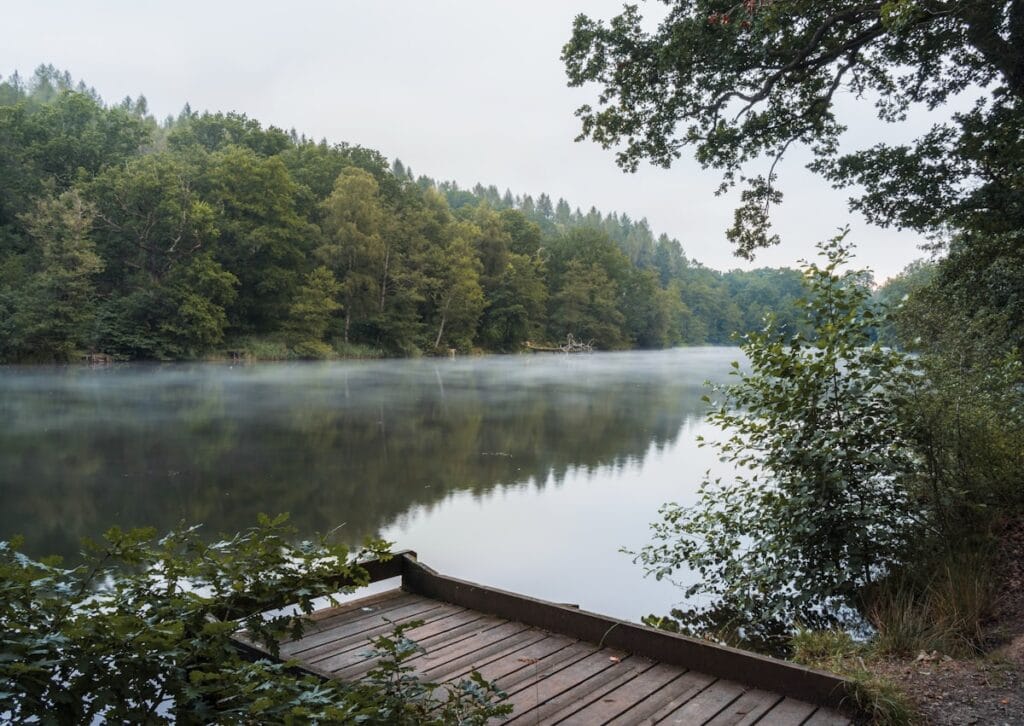
When shallow bass disappear in the summer heat, the fish don’t vanish — they migrate to ledges. Ledge fishing is the most productive deep-water bass technique from June through August, and it’s responsible for some of the biggest tournament hauls ever recorded. Here’s everything you need to know.
What Is a Ledge?
A ledge is a distinct drop-off or shelf where the bottom transitions from a shallower flat to deeper water. Think of it like a stair step on the lake floor. Bass use the edge of the drop as a highway, moving up to feed and retreating to the deeper side when conditions push them off.
Classic ledges form where old creek channels or river channels cut through a lake floor. Reservoirs built by flooding river valleys are loaded with ledges — the old riverbed creates natural structure at 15 to 30+ feet of water.
Why Bass Use Ledges in Summer
As surface temperatures climb above 80°F, bass face physiological stress in shallow water. They seek three things in summer: cooler temperatures, higher dissolved oxygen, and proximity to baitfish. Ledges deliver all three.
Threadfin and gizzard shad school up over main lake structure in summer. Bass position on the ledge edge directly beneath the shad schools, ambushing them from below. When you find shad suspended over a ledge on your graph, bass are almost certainly underneath.
How to Find Ledges
Use Contour Maps and Navionics
Before you ever launch your boat, spend an hour studying your lake’s contour map on Navionics or a similar app. Look for areas where depth contour lines are tightly packed — that’s where the bottom drops quickly. The old river or creek channel running through the lake is prime real estate.
Key Ledge Features to Target
Not every inch of a ledge holds fish. Focus on:
- Points on the ledge: Where the ledge juts out into the creek channel like a finger. Bass stack on these points because they intercept baitfish from multiple directions.
- Inside bends: Slower current historically deposited gravel and harder bottom at the inside of creek channel bends. Bass prefer hard bottom over mud.
- Hard-to-soft transitions: Where the bottom composition changes. Use your graph to identify differences in bottom hardness.
- Brush piles and stumps: Any vertical structure on or near a ledge concentrates fish further. Many anglers sink their own brush piles on productive ledges.
Reading Your Depth Finder
A quality graph (Humminbird, Lowrance, or Garmin) in side-imaging or down-imaging mode is essential for ledge fishing. You’re looking for:
- The distinct color change at the drop-off edge
- Schools of shad (cloud-like blobs suspended above the bottom)
- Bass sitting on or just above the bottom, often appearing as individual arches
- Hard vs. soft bottom (brighter returns = harder substrate)
Make multiple passes over a ledge before declaring it empty. Idle across the structure to mark fish, then back off and cast to them. Don’t run over them with your boat before fishing.
Best Baits for Ledge Fishing
Big Crankbaits — Primary Search Tool
A deep-diving crankbait that reaches 15–25 feet is the quintessential ledge fishing bait. Models like the Strike King 6XD, 8XD, 10XD, Rapala DT16/DT20, or Luck E Strike RC 2.5 are proven performers. The bait deflecting off the ledge edge triggers reaction strikes from bass that won’t chase.
Use 10–12 lb fluorocarbon on a long 7’6″ to 8′ moderate action rod for maximum depth penetration and casting distance. Long casts are critical — you want the bait diving to depth before it hits the structure.
Football jig — When Bass Are Tight to Bottom
A 3/4 oz to 1.5 oz football jig with a chunky crawfish trailer is a ledge fishing staple. It ticks across the bottom naturally, imitating a crawdad, and the heavy head stays in contact with the substrate. Drag it slowly along the ledge edge and let it fall off the drop.
Craw colors (green pumpkin, brown, orange) and darker natural tones work best. Match the bottom color as much as possible.
Swimbait — For Suspended Fish
When bass are chasing shad and suspended off the bottom, a large swimbait (5–8 inches) on a heavy head matches the hatch perfectly. Swim it at the same depth level as the fish you see on your graph. A swimbait can out-produce everything else when bass are in a shad-chasing mood.
Carolina Rig — Covering Ground
A 3/4 oz Carolina rig with a 18–24″ leader and a soft plastic (lizard, creature bait, or big worm) is an excellent ledge fishing tool. The weight bounces along the ledge while the bait floats and flutters behind it. It’s a great way to cover a long stretch of ledge methodically.
Drop Shot — When They Won’t Commit
On tough days or in post-frontal conditions, downsizing to a drop shot can keep you catching when the big presentations fail. A 3/8 oz weight with 18″ of leader and a finesse worm (Roboworm, Z-Man Trick ShotZ) targets individual fish you can see on your graph.
Ledge Fishing Technique: Step-by-Step
- Mark fish on the graph — Idle over the ledge multiple times. Mark waypoints where you see fish or good structure.
- Position the boat — Set up in deeper water and cast toward the ledge. Keeping the boat deep lets you work the bait up the drop instead of diving into the structure from above.
- Make long casts — With crankbaits, you need 50+ foot casts to get the bait down to depth before it hits the structure. Use a longer rod and 10 lb fluoro for max depth.
- Stay in contact with the bottom — The strike often happens right when the bait deflects off the ledge edge. Feel for that “tick” and be ready.
- Work all angles — Cast parallel to the ledge, perpendicular to it, and at 45-degree angles. Different presentations trigger different fish.
- Stay on active fish — When you catch one, mark the spot and keep fishing it. Ledge fish school up; where there’s one there are often 20.
When Ledge Fishing Produces Best
Prime ledge fishing is June through early September in most parts of the country. The summer heat has pushed fish off the banks, and stable high pressure keeps them in predictable deep-water locations. Weekday fishing is often better than weekends — boat traffic disrupts suspended fish.
The best bite windows on ledges are similar to shallow fishing: early morning and late evening. But on overcast days or with light wind creating chop, the midday bite on deep ledges can be outstanding while shallow anglers struggle.
Final Thoughts
Ledge fishing requires an investment in electronics and technique, but it unlocks some of the most productive summer bass fishing available. While most anglers are throwing topwater in two feet of water at dawn and going home frustrated by 9 AM, ledge fishermen are putting together 20-pound stringers in the middle of the day. Learn to read your graph, find the fish, and present the right baits — and summer bass fishing will never frustrate you again.
❓ Frequently Asked Questions
What is ledge fishing for bass?
Ledge fishing targets deep drop-offs where old creek or river channels cut through the lake floor. Bass use these ledges as summer feeding stations, positioning below suspended shad schools and ambushing them from the depth. It’s the dominant summer technique on southern reservoirs.
How deep are bass on ledges?
Summer ledge bass typically hold at 15–25 feet of water, often suspended just above the ledge edge or sitting tight on the bottom in 20–30 feet. Use your depth finder to locate the exact depth of active fish before choosing your presentation.
What is the best bait for ledge fishing bass?
Deep-diving crankbaits (Strike King 10XD, Rapala DT20) and football jigs (3/4–1.5 oz) are the top ledge fishing baits. Crankbaits cover water fast to locate fish; football jigs work the bottom precisely once you find where they’re holding.
Can you ledge fish without a boat?
True ledge fishing requires a boat to reach and work offshore structure. However, many lakes have ledges that come close to accessible bank points or bridge causeways. Study a contour map to find where the channel swings close to a bank you can reach.
📖 Keep Reading
Sandro
Bass Fishing Enthusiast & Founder of Bass Fishing Blueprint
Sandro has been chasing bass from the bank and the boat for over a decade. He created Bass Fishing Blueprint to share straightforward, practical tactics that help everyday anglers catch more fish â no fluff, no filler, just what actually works on the water.