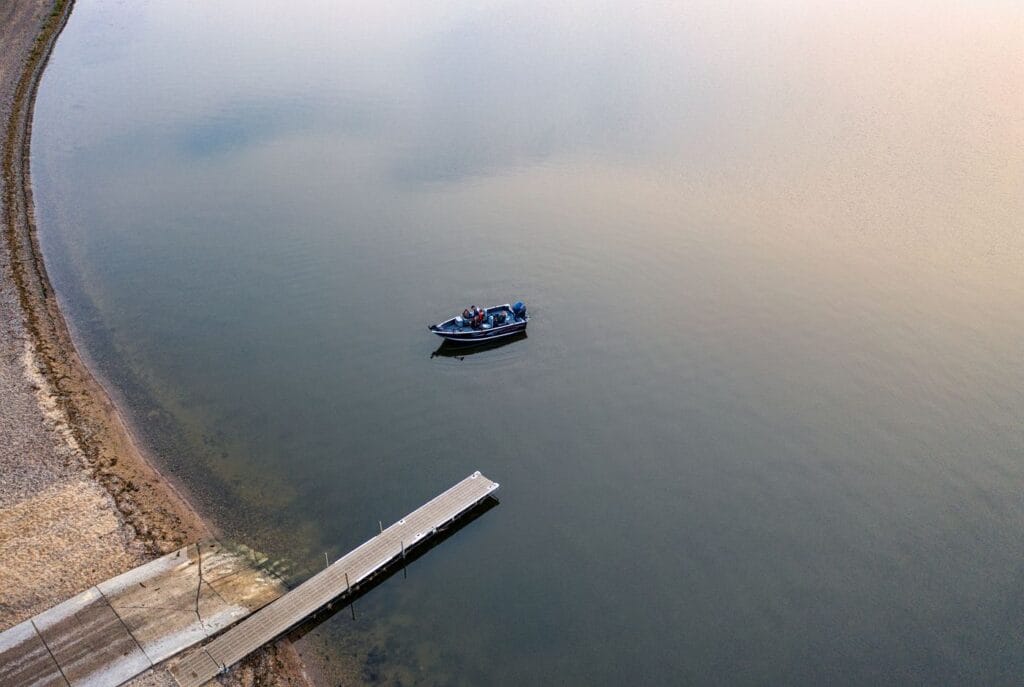
If you had to fish one type of structure for the rest of your life, a main lake point would be a defensible choice. Points hold bass in every season, on almost every lake in North America, and they offer the rare combination of being easy to find on a map and easy to fish efficiently from a boat or the bank. Yet most anglers either drive past them looking for something flashier or fish them in a way that leaves the best fish untouched. This guide walks through how to read a point, what to throw, and how to adjust by season so you stop wasting points and start catching off them.
What Counts as a Main Lake Point?
A main lake point is any piece of land that extends out into the main body of a lake or reservoir, with deeper water surrounding it on multiple sides. Secondary points sit inside creek arms and coves; main lake points jut into the open lake itself. The defining feature is access — a main lake point connects shallow shoreline structure directly to deep water, which means bass can move shallow to feed and slide deep to rest with almost no travel.
That access is exactly what makes them so productive. A point essentially funnels every bass that wants to move between depth zones across the same piece of bottom — and that is where you want your bait.
How to Read a Point
Before your first cast, take ten minutes to study the point. Use a contour map app to see how the point extends underwater, then idle around with your sonar to confirm. The features that consistently hold the most bass are:
- The end of the point — where the point finally drops into the channel or main basin. This is the deepest staging spot and almost always holds bass.
- The shoulders — where the sides of the point meet the main lake. The downwind shoulder collects bait and is usually the most productive.
- Channel swings — places where the main creek or river channel comes closest to the point. These breaks concentrate bass.
- Hard-bottom transitions — gravel to mud, rock to clay, or chunk rock to pea gravel. Bass live on these seams.
- Cover on top — isolated brushpiles, stumps, laydowns, or grass clumps. A point with cover always beats a clean point.
- Secondary breaks — small drops of just one to three feet on top of the point. These hold midday fish even on bright days.
The single highest-percentage spot on any point is where two or more of those features overlap. A brushpile sitting on a hard-bottom transition right at the channel swing on the downwind shoulder is a community hole that gets fished by every local — and for good reason.
Season-By-Season Point Strategy
Pre-Spawn (Late Winter to Early Spring)
Bass stage on the deeper ends of main lake points adjacent to spawning bays. The classic pre-spawn point is one that drops sharply on one side into a creek channel and tapers gradually toward a spawning flat on the other side. Throw suspending jerkbaits, lipless crankbaits, and small swimbaits across the deeper end and along the transition. A football jig dragged on the gravel break catches bigger pre-spawn females.
Post-Spawn and Early Summer
This is the prime point window for many lakes, and it lines up perfectly with mid-May through June. Bass are pulling out of spawning pockets and stacking on the first deep structure they hit on the way out — often the secondary points first, then the main lake points as water warms. Topwater walking baits at first light, squarebill crankbaits across the shallow end, and a Carolina rig or shaky head on the deeper edge will cover the column. Look for shad spawning on the rocky shoulders early — bass will be right behind them.
Summer
Summer is the deep-point season. Bass slide out to the ends of main lake points and stack on offshore brush, ledges, and channel swings. Big deep-diving crankbaits, magnum swimbaits, football jigs, and Carolina rigs are the workhorses. Use your electronics — these fish are findable on side-imaging and forward-facing sonar, and once you locate a school you can sit on it for hours.
Fall
Fall bass follow shad out of creeks and stack on the first main lake points outside the creek mouth. Spinnerbaits, lipless cranks, jerkbaits, and topwater all produce as bass push bait against the shallow end of the point. The wind side is critical in fall — a slick point usually means dead water, but a point with whitecaps breaking on it can be a school city.
Winter
Steep main lake points adjacent to deep wintering basins are textbook cold-water spots. Slow-rolled blade baits, jigging spoons, hair jigs, and small finesse jigs fished vertically on the channel side put bass in the boat when nothing else does. Fish slowly and stay on the contour break.
How to Cover a Point Efficiently
The biggest mistake on a point is making the same cast forty times in a row. A point is a three-dimensional piece of structure and you have to fish it that way. A simple checklist:
- Start with a horizontal moving bait — squarebill, spinnerbait, or jerkbait — and fan-cast both shoulders, the top, and the end.
- Switch to a deeper-running crank or swimbait to cover the same area at the next depth band.
- Slow down with a Carolina rig, football jig, or shaky head and pick apart the transitions and offshore brush.
- Once you find the depth and angle that produces, repeat that cast and ignore the rest until the bite slows.
Wind, Sun, and Other Variables
The same point can fish completely differently from day to day. Wind blowing into a point pushes bait and pulls bass shallow. Sun on the point pushes bass to the shaded side or out to deeper cover. A pressure drop ahead of weather lights up the bite; a bluebird high pressure bluebird day pushes fish onto the deepest brush. Rather than abandoning a point that did not produce yesterday, ask what changed and where the fish likely repositioned.
Bank Anglers and Points
Main lake points are some of the best bank-fishing spots on any lake because they put deep water within casting distance of shore. Walk to the very tip of the point and fan-cast a deep-diving crankbait, a Carolina rig, or a heavy swimbait into the channel. Then work parallel to both shoulders. Wind in your face is uncomfortable but typically the most productive angle to fish a point from the bank.
Final Thoughts
Main lake points are the most versatile, year-round structure on any reservoir or natural lake. Spend time learning two or three points on your home water — really learning them, with multiple bait types and across all four seasons — and you will catch more bass than the angler who runs twenty banks looking for a magic spot. The bass tell you the pattern; the point gives you a stage on which they have to show themselves. Slow down, fish the whole structure, and let the seasonal cues guide your bait choice.
Sandro
Bass Fishing Enthusiast & Founder of Bass Fishing Blueprint
Sandro has been chasing bass from the bank and the boat for over a decade. He created Bass Fishing Blueprint to share straightforward, practical tactics that help everyday anglers catch more fish â no fluff, no filler, just what actually works on the water.