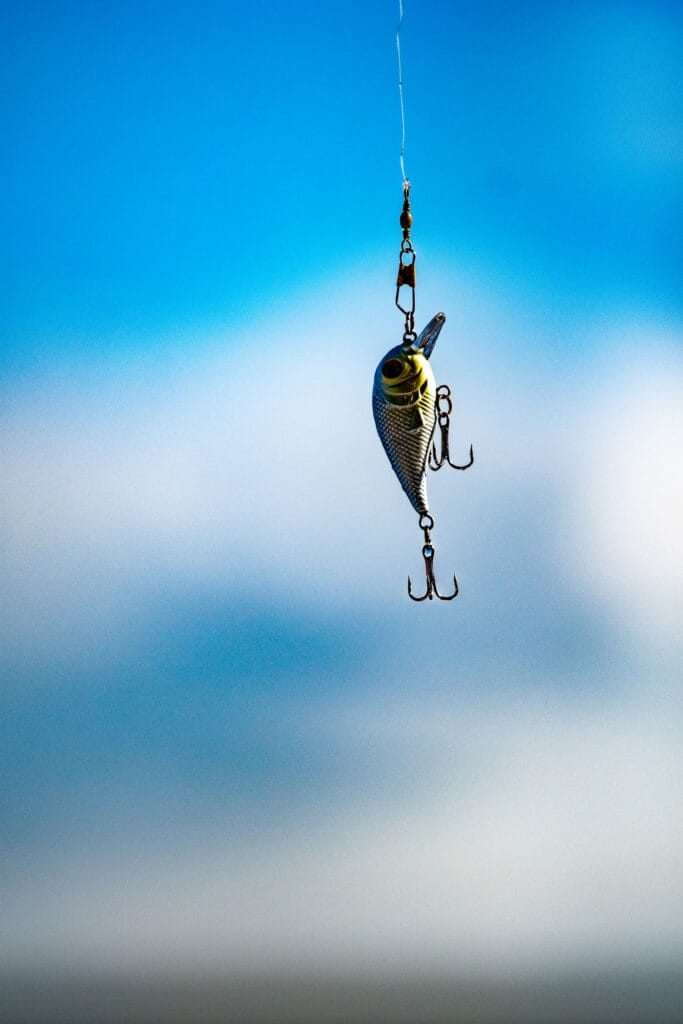
By late summer, most bass on highland and lowland reservoirs have pulled out to deep structure and set up on ledges, humps, and channel drops. Anglers throw deep crankbaits, football jigs, and Carolina rigs at these fish—but there is one bait that outfishes them all when a school is fired up and feeding on gizzard shad: the flutter spoon. If you have never fished a big, wobbling slab of metal, you are leaving some of your biggest summer bass in the water.
What a Flutter Spoon Is (and Why It Works)
A flutter spoon is a large, thin, concave piece of metal—usually 4 to 6 inches long and weighing 3/4 to 1-1/2 ounces—that mimics a dying or fleeing shad. Unlike a compact jigging spoon, a flutter spoon has a wide, erratic wobble on the fall. That kill-shot flutter is the whole point: it perfectly imitates the gizzard shad that big summer bass gorge on offshore. When a school of bass is holding on a ledge, a flutter spoon crashing down through them triggers a reaction strike from fish that have seen every crankbait and worm in the tackle shop.
Popular examples include the Nichols Ben Parker Magnum Spoon, the War Eagle Jiggin Spoon in the larger sizes, and the Strike King Sexy Spoon. The Ben Parker in particular put this technique on the map on the Tennessee River, where anglers throw the 8-inch version at fish gorged on huge shad.
The Gear You Actually Need
This is not a technique for finesse tackle. A 5- to 8-inch spoon is heavy and wind-resistant, and you will be making long casts and lifting that weight all day. Set yourself up correctly:
- Rod: A 7-foot-3 to 7-foot-6 heavy-power rod with a moderate tip. You need backbone to move the spoon and enough tip to keep from ripping the bait away from short-striking fish.
- Reel: A baitcaster in the 7.1:1 to 7.5:1 range. You want to pick up line quickly when a fish eats on the fall and swims toward you.
- Line: 15- to 20-pound fluorocarbon for most situations. Fluoro sinks and gives the spoon a natural fall. Braid to a fluoro leader works in deeper, snaggier water.
- Split rings and swivels: Add a quality barrel swivel 12 to 18 inches up the line to kill line twist—a spinning spoon will twist line badly without one.
Finding the Right Fish First
The flutter spoon is a school-fishing bait, not a search bait. You need to locate bass before you tie one on. Idle main-lake ledges, points, and channel swings in 12 to 30 feet of water and watch your electronics for two things: bait and arches. Big schools of gizzard shad show up as clouds, and the bass will be under or beside them, often stacked tight to the bottom or suspended just off it. If you have forward-facing sonar, you can watch fish react to the spoon in real time, but a good 2D and down-imaging picture is more than enough to get started.
Look for the sweet spots on a ledge: a subtle turn in the drop, a shell bed, an isolated rock, or a piece of brush. Bass position on these irregularities. Once you mark a wad of fish, back off, make a long cast past them, and get ready.
How to Fish the Flutter Spoon
There are two primary presentations, and both catch fish.
The Stroke-and-Fall
Make a long cast and let the spoon fall on a semi-slack line all the way to the bottom. Watch your line—most strikes come on that first fall. When it hits bottom, sweep the rod tip up hard and fast, ripping the spoon 3 to 6 feet off the bottom, then follow it back down with your rod tip, keeping just enough tension to feel the bait but letting it flutter freely. That free fall is when 90 percent of your bites happen. If your line jumps, ticks, or goes slack early, reel down and swing.
The Yo-Yo Over Suspended Fish
When bass are suspended off the bottom chasing bait, count the spoon down to their depth and work it with shorter lifts and drops, keeping it in the strike zone longer. This is where forward-facing sonar shines—you can put the spoon right on their heads and watch them commit.
Detecting and Landing Bites
Flutter spoon bites are rarely a hard thump. Because the fish eats the bait as it falls, you will usually just feel weight, a mushy tick, or your line swimming off to the side. Any time the spoon does not fall the way it should, set the hook. Sweep-set hard to move the heavy bait and drive the big single hook home. Keep steady pressure on the way up—that oversized treble or single hook has a lot of leverage, and fish will throw a heavy spoon if you give them slack.
Upgrade the stock hardware. Many spoons come with an undersized split ring and a mediocre hook. Swap in a heavy-duty split ring and a sticky-sharp 4/0 to 6/0 treble or feathered single, and you will land far more of the giants this bait attracts.
When the Flutter Spoon Shines
- Post-front, tough conditions: When a school shuts down and quits eating a crankbait, a spoon crashing through them often triggers a reaction bite.
- Big-shad lakes: Anywhere gizzard shad grow large—Tennessee River lakes, Kentucky Lake, Guntersville, big Texas and Oklahoma reservoirs—the magnum spoon excels.
- Cleaning up after a crankbait: Crank a school to catch the aggressive fish, then follow up with a spoon to pick off the ones that would not chase.
- Deep, vertical situations: Standing timber, bluff ends, and deep brush where you need a vertical presentation.
A Few Hard-Won Tips
- Use a rod holder or keep your reel in free spool with your thumb on the spool during the fall—slack-line bites are easy to miss if you are reeling.
- Do not over-work the bait. One or two hard strokes followed by a long controlled fall beats frantic jigging.
- If you are twisting line despite a swivel, your spoon may be helicoptering—slow your fall and make sure your line-tie and split ring spin freely.
- Match the size to the forage. If shad are 3 inches, a 4-inch spoon may outproduce a giant one, and vice versa in big-shad systems.
The flutter spoon has a reputation as a big-fish bait for a reason: it calls up the largest bass in a school and triggers them when nothing else will. It takes a little confidence to keep throwing a giant slab of metal, but the first time a 6-pounder inhales it on the fall, you will understand why the offshore crowd never leaves the dock without one. Add it to your late-summer arsenal and start fishing the fish everyone else drives past.
Sandro
Bass Fishing Enthusiast & Founder of Bass Fishing Blueprint
Sandro has been chasing bass from the bank and the boat for over a decade. He created Bass Fishing Blueprint to share straightforward, practical tactics that help everyday anglers catch more fish â no fluff, no filler, just what actually works on the water.