The first rod I ever owned was a five-dollar fiberglass stick my uncle pulled out of his garage. It had no real action to speak of, the handle was half-wrapped in electrical tape, and the line guide on the tip was held on with what I’m pretty sure was a rubber band. I caught dozens of bass on that rod. Didn’t know any better. Didn’t need to.
But as I got older and started spending more time on the bank — more serious time, thinking about techniques and presentations instead of just chucking whatever was in reach — I started to understand why rod and reel setup actually matters. Not in a gear-snob way. In a functional way. The right setup makes certain presentations easier, gets you more distance on your cast, and helps you feel what’s happening on the other end of your line.
This isn’t about spending a lot of money. I’ve caught plenty of bass on sub-$50 combos. But I want to walk you through what to actually look for — and give you my honest picks at different price points — so you’re not wasting money on the wrong things.
The One Setup Every Bank Fisher Needs First
If you only have one rod and you fish the bank, make it a 7-foot medium-heavy with a fast action tip. That’s the all-around setup. It handles soft plastics, spinnerbaits, jigs, and most topwater. It’s long enough to load up on a cast and get some distance. The medium-heavy power gives you backbone for the hookset and enough muscle to pull fish out of cover, and the fast action tip gives you sensitivity so you can feel subtle bites on the fall.
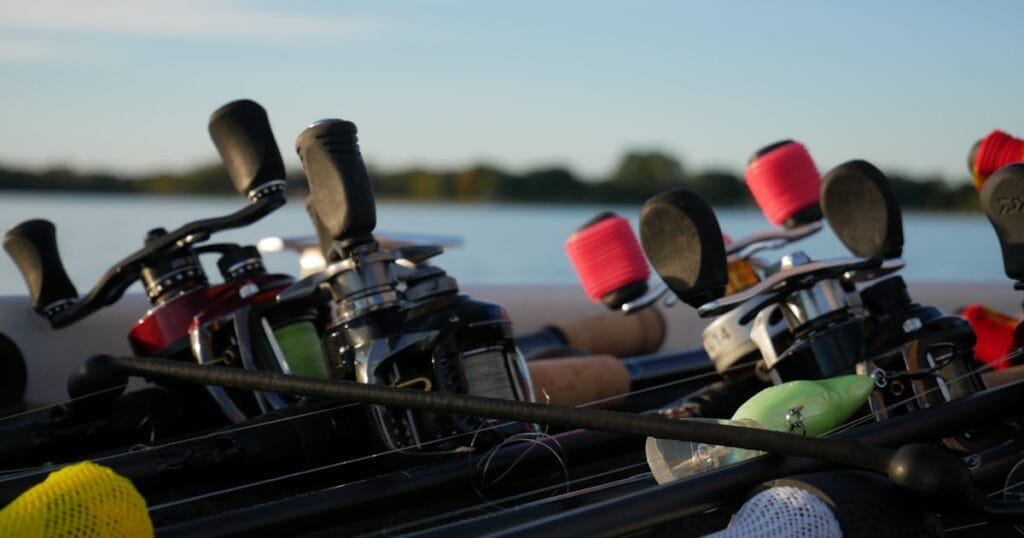
For the reel, I want a baitcasting reel if I’m fishing lures heavier than 1/4 oz — something in the 7:1 gear ratio range. For lighter stuff, finesse tactics, or if you’re newer to casting, a spinning reel in a 2500 or 3000 size is the right call. There’s no shame in spinning gear. Some of the best bank fishers I know throw spinning exclusively and do just fine.
The Best Budget Setup (Under $100 Total)
The Ugly Stik GX2 in 7-foot medium-heavy paired with a Pflueger President spinning reel is the combination I’d hand to anyone who wants solid fishing gear without dropping serious money. I’ve seen this combo in the hands of kids who couldn’t cast fifteen feet and seasoned guys who could lay a Senko into a twelve-inch gap between two dock posts. It handles both.
The GX2 is practically indestructible. The fiberglass blend in the tip makes it forgiving, which is a nice way of saying it bends without breaking when you do something dumb with it. The Ugly Stik Clear Tip design lets you see the tip bounce on the lightest bite — something a lot of more expensive rods won’t show you as clearly. It’s not a sensitive rod, but it’s honest, it’s tough, and it’ll last years.
The Pflueger President is the best spinning reel under $60, full stop. It’s smooth, it has a decent drag, and it’s been around long enough that the design problems got worked out decades ago. Spool it with 10 lb fluorocarbon and you’ve got a rig that’ll handle everything from a Ned rig to a 3/8 oz spinnerbait.
The Best Mid-Range Setup ($100–$200)
Once you’ve got some experience and you know what presentations you gravitate toward, it’s worth stepping up. The rod makes more of a difference than the reel in this range — so spend more on the rod.
The St. Croix Bass X series is where I’d start. St. Croix is an American company based out of Park Falls, Wisconsin, and they build rods that feel like they cost twice what they do. The Bass X in a 7-foot medium-heavy fast action is incredibly sensitive for the price — you’ll feel rocks, gravel, and light bites that would be lost in muffled feedback on a cheaper rod. The guides are solid, the SCII graphite blank is light, and the action is exactly what you’d want for most bank fishing applications.
Pair it with a Shimano Stradic FL in 2500 or 3000 size and you’ve got a spinning combo that serious anglers use. The Stradic is smooth in a way that’s hard to explain until you pick one up and crank the handle. No grinding, no wobble. The drag is consistent and pulls smoothly. It’s the kind of reel that makes you realize how much of your tackle budget you were previously wasting on things that weren’t the reel.
The Best Setup for Throwing Heavier Lures (Baitcasting)
If you’re flipping jigs, fishing spinnerbaits, throwing big Texas rigs, or doing anything that involves lures heavier than 3/8 oz, you’ll eventually want a baitcasting setup. The casting efficiency, line control, and power transfer with a baitcaster is just better for that style of fishing.
The Lew’s Tournament M1 Speed Stick paired with a Lew’s Tournament MB Speed Spool is a combination I’ve fished for a long time and recommend without hesitation. The M1 in 7’3″ medium-heavy heavy has a sensitive enough tip to feel jig bites and enough backbone to move fish. The Speed Spool has a smooth magnetic brake system that’s easy to dial in for bank fishing distance casts. Lew’s makes quality gear, prices it fairly, and doesn’t go out of their way to confuse you with 47 nearly identical models.
For pure value in baitcasting, the Abu Garcia Revo Beast or the Daiwa Tatula CT are also worth serious consideration. The Tatula CT in particular is exceptionally smooth for what it costs and casts a 3/8 oz jig a country mile.
What Line Should You Spool It With?
Short answer for bank fishing: fluorocarbon on spinning gear, fluorocarbon or braid-to-fluoro leader on baitcasting gear.
For spinning reels, 10 lb fluorocarbon as a main line handles most situations. Sunline Super FC Sniper and Seaguar Invizx are both excellent. They sink, they’re low-vis, and they’re stiff enough to manage on a spinning reel without becoming a bird’s nest on every cast.
For baitcasting reels, I’ll either spool straight 15-17 lb fluorocarbon or go 30 lb braid with a 12-15 lb fluoro leader tied on with an Alberto or FG knot. Braid has zero stretch which makes it ideal for feeling bottom composition and getting hard hooksets on long casts. But it’s visible, so the leader keeps things honest in clear water.
One thing to avoid: cheap monofilament as your main line. Mono has too much memory, especially in cold weather, and it stretches in a way that robs you of sensitivity and hookset power. Spend a few extra dollars on quality fluorocarbon. It makes a bigger difference than most of the rod or reel upgrades people obsess over.
A Quick Note on Rod Length for Bank Fishing
Longer rods are generally better for bank fishing. A 7-foot rod versus a 6’6″ gives you meaningfully more casting distance — which matters when you can’t reposition a boat to get closer to your target. The extra length also helps with line management when fish run toward you after the hookset, because you can drop the tip and still keep pressure on.
I wouldn’t go past 7’6″ for most bank fishing applications. Past that you start fighting the rod on close-quarters pitches and flips, and casting accuracy takes a hit. The sweet spot is 7 to 7’3″ for most setups, with a 7’6″ only if you’re doing a lot of long-distance casting to deep structure.
The Bottom Line
Don’t let gear anxiety keep you off the water. A $50 combo from a big-box store will catch bass. The Ugly Stik and Pflueger President combo above will catch bass just as well as a $400 setup, just with less sensitivity and slightly more fatigue on long days. Skill, knowledge of where fish are and what they want — that’s 90% of it.
Buy the best setup you can reasonably afford, learn it inside and out, and spend as much time on the bank as possible. That’s the path. Gear is a tool. Time on the water is the education.
❓ Frequently Asked Questions
When is the best time for spring bass fishing?
The best spring bass fishing is during pre-spawn when water temperatures are between 55–65°F. Bass are feeding aggressively to bulk up before the spawn. This typically runs from March through early May depending on your location.
What depth are bass in spring?
In early spring, bass stage on points and channel edges at 6–15 feet. As water warms into the mid-60s°F, they move shallower to 2–8 feet for spawning.
What is the best lure for spring bass fishing?
Jigs with crawfish trailers, lipless crankbaits, and suspending jerkbaits are the most productive spring bass lures. Match the presentation to water temperature — slower finesse baits in colder water, faster reaction baits as temps rise.
📖 Keep Reading
Frequently Asked Questions
What is the best rod length for bank fishing bass?
A 7-foot medium-heavy rod is the most versatile choice for bank fishing bass. It gives you enough casting distance to reach fish from shore, enough backbone to set the hook on plastic rigs, and enough sensitivity to detect bites. A 7-foot medium rod is better for finesse presentations.
Should I use a spinning or baitcasting reel for bank fishing?
Beginners should start with a spinning reel — it is easier to use, handles lighter lines better, and is less prone to backlash. Intermediate to advanced anglers often prefer a baitcasting reel for heavier lures and more precise casting. Many bank fishermen carry both setups.
What pound test line is best for bank fishing bass?
10-17 lb fluorocarbon or 15-30 lb braid are the most popular choices for bank fishing bass. Use 10-12 lb fluorocarbon for finesse techniques and clear water. Use 17 lb fluorocarbon or 20 lb braid for flipping, frogging, or fishing near heavy cover.
Sandro
Bass Fishing Enthusiast & Founder of Bass Fishing Blueprint
Sandro has been chasing bass from the bank and the boat for over a decade. He created Bass Fishing Blueprint to share straightforward, practical tactics that help everyday anglers catch more fish â no fluff, no filler, just what actually works on the water.